Why Degrees Alone Are No Longer Enough
Dec 16, 2025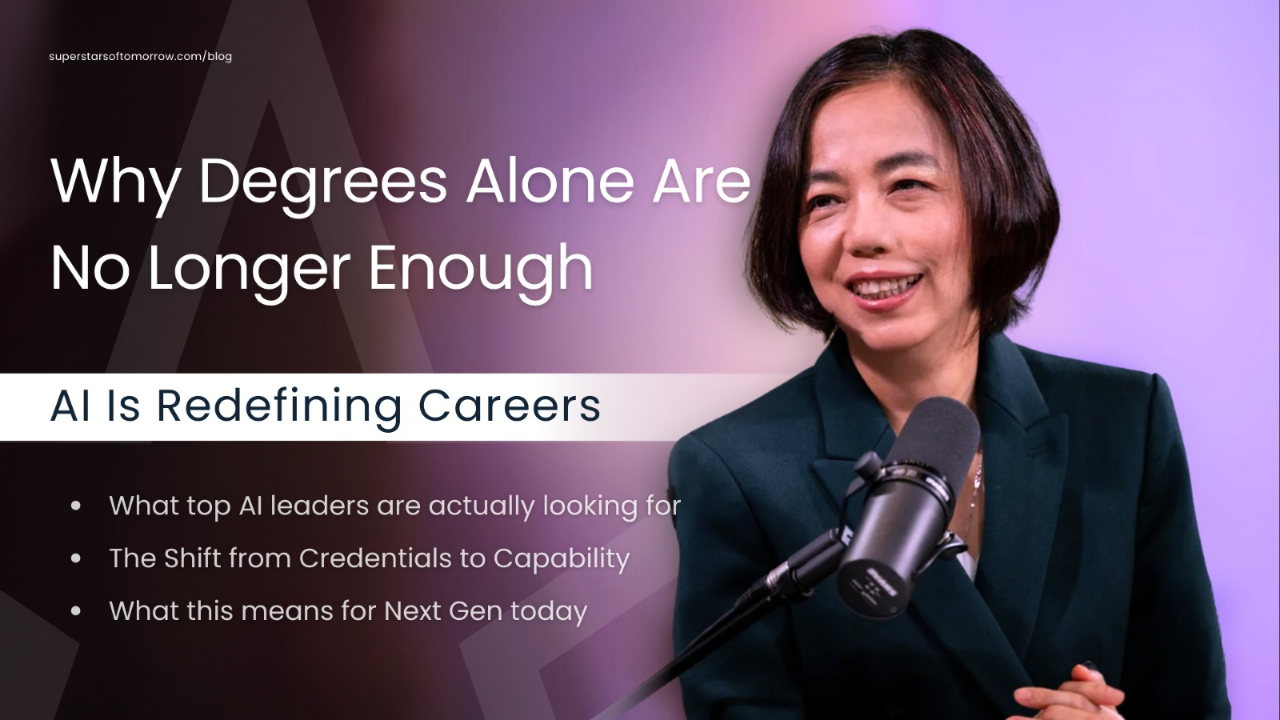
Often called the “Godmother of AI,” Fei-Fei Li is a Stanford professor and the CEO of AI startup World Labs. She has spent decades working at the intersection of technology, research and real-world application.
AI Is Redefining Careers
When Fei-Fei Li speaks about the future of work, people listen.
In interviews, she has shared a clear message: when hiring today, degrees matter far less than how people learn and use modern tools.
In one conversation, she explained that when interviewing software engineers, she no longer focuses on academic credentials. Instead, she looks at experience, adaptability, and a candidate’s relationship with AI tools. What matters most, she says, is mindset—how quickly someone can learn and “superpower themselves” using new technology.
That insight reflects a much bigger shift happening across industries.
The Shift from Credentials to Capability
For years, degrees were treated as proof of readiness. They signaled knowledge, discipline, and potential. While education still has value, it is no longer a reliable indicator of how someone will perform in a fast-changing world.
According to Fei-Fei Li, hiring decisions today are based on practical ability. Employers want to know:
- What tools do you use in your daily work?
- What have you learned beyond your degree?
- How fast can you adapt when technology changes?
AI has accelerated this shift. Tools evolve quickly, and those who wait for formal education to catch up often fall behind. Capability now matters more than credentials.
Why AI Skills Matter More Than Ever
AI tools are no longer limited to engineers or researchers. They are used in writing, design, analysis, planning, communication and decision-making. Learning how to work with AI is becoming a basic career skill.
Degrees provide a foundation, but they cannot keep pace with rapid change. What truly matters is whether someone can continue learning long after graduation.
This is why mindset is now critical. People who experiment, stay curious and learn through doing are better prepared than those who rely only on formal qualifications.
What This Means for Next Generation
For Gen Z, this shift is not a disadvantage—it is an opportunity.
Careers are no longer locked behind traditional paths. What matters most is the ability to learn, adapt and apply new tools. AI rewards those who move early, explore freely and build real-world skills.
Instead of asking, “What degree should I get?” the better question is:
“What skills am I building and how fast am I learning?”
Curiosity, flexibility and hands-on experience now shape success more than titles or certificates.
A New Definition of Career Readiness
Degrees still matter—but they are no longer enough on their own.
In the age of AI, career readiness means being able to learn continuously, adapt quickly and work confidently with evolving tools. Those who develop this mindset will stay relevant, no matter how industries change.
As Fei-Fei Li reminds us, the future belongs to those who know how to grow with technology—not just study it.
That is the real advantage in an AI-driven world.