How Sarah Friar sees the future of Finance
Feb 03, 2026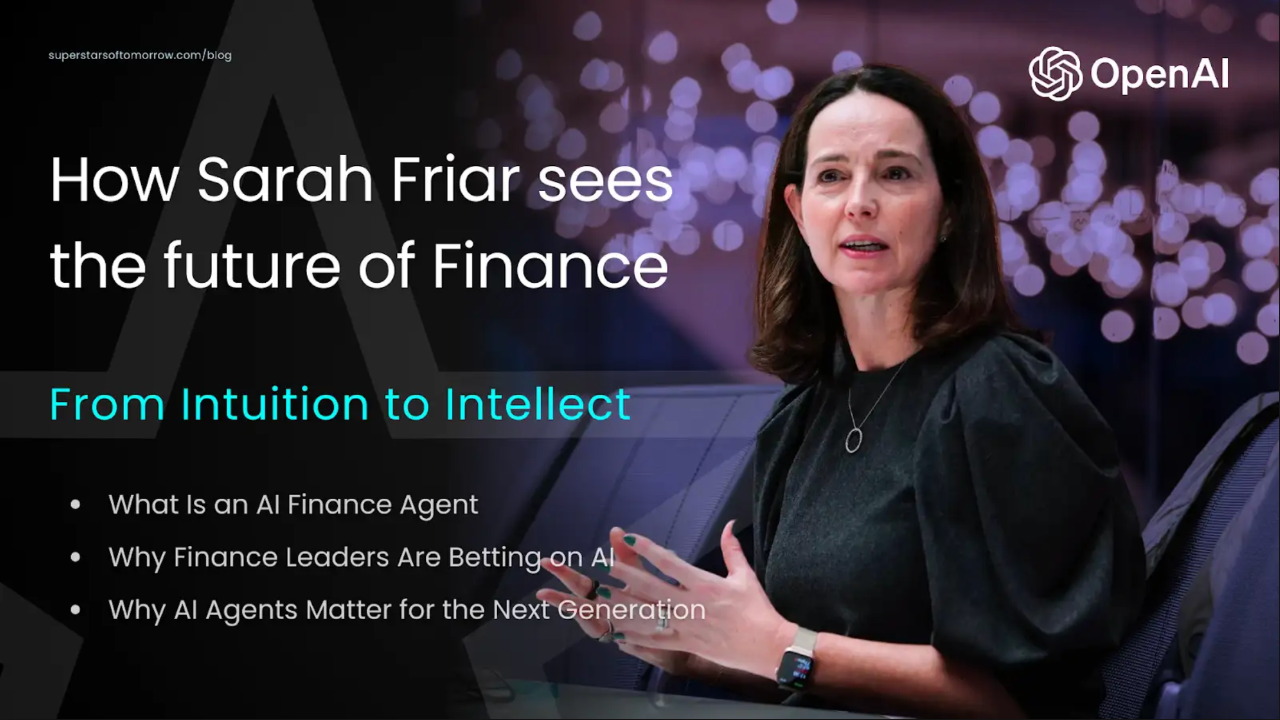
One of the strongest voices behind this shift is Sarah Friar, CFO of OpenAI. As a finance leader inside an AI-first company, she often speaks about how AI will reshape how finance teams think, decide and operate.
The Future of Finance Is Being Rewritten by AI
Finance is no longer just about reports, spreadsheets, and closing books. It’s becoming faster, smarter and more predictive — powered by AI.
One of the strongest voices behind this shift is Sarah Friar. In multiple interviews she’s spoken plainly about how AI will transform not just tech, but business operations and finance itself.
Her message is clear: “The future of finance won’t be manual. It will be agent-driven.”
Why Finance Leaders Are Betting on AI
Traditional finance works in hindsight. AI-powered finance works in real time. This shift is where AI finance agents come in.
Sarah Friar has said plainly:
“The people who will get left behind are not embracing AI fast enough.”
She warned that those who use AI deeply will be the ones disrupting industries — not AI itself. She highlights how modern finance teams must move from: reporting what happened to understanding what’s happening now and predicting what happens next.
This isn’t hype. It’s a call to action for companies and finance teams to adopt AI tools now or risk falling behind.
What Is an AI Finance Agent?
An AI finance agent is not a dashboard. It’s not a chatbot. It’s a system that can: track financial data continuously, spot risks and opportunities, suggest actions and automate routine decisions.
Here’s what AI Finance Agents can actually do today:
- Smarter Risk & Fraud Detection: By continuously analyzing transactions and patterns, AI agents spot fraud and abnormal behavior faster than manual systems.
- Dynamic Forecasting & Cash Flow Insights: Instead of static budgets, agents update forecasts in real time based on live data — giving finance teams forward-looking views on spending, revenue and liquidity.
- Automated Reporting & Reconciliation: Agents can gather data from multiple sources, check for discrepancies and generate accurate reports without hours of human effort.
- Personalized Financial Planning: For individuals or businesses, agents can suggest investment strategies, optimize debt, and tailor financial plans using predictive analytics.
At the McKinsey At the Edge podcast, Friar explained how OpenAI already uses AI inside its own finance teams:
“We built an investor relations custom GPT… that allows us to answer questions in seconds that previously took hours or a whole day.”
This is a real example of how finance works — from data unification to reporting — can be automated and accelerated with AI.
From CFO Intuition to AI-Supported Decisions
Finance leaders like Friar talk about a key change: intuition alone is no longer enough. She wants finance teams to shift from looking backward to looking forward:
“Today’s finance department is still so much the look back, not the look forward… I hope in five years we’ll look back and think how outdated today’s methods were.”
This forward-looking mindset is exactly what AI agents enable — freeing humans from repetitive tasks so they can focus on strategy and insight.
Why AI Agents Matter for the Next Generation
For Gen Z leaders, finance won’t start with formulas in Excel. It will start with systems, automation and intelligent tools.
AI finance agents are becoming core to: modern corporate finance functions,strategic planning,automation and forecasting and dynamic risk management.
Understanding them early is no longer optional — it’s the edge that tomorrow’s leaders will use to outperform competitors.